Semiramide

Updated: Jun 19
Semiramide is grande opera and Rossini at his serious best, starting with a serious legend via Voltaire and embellishing it with massive choruses and formidable bel canto recitals.

The story
Voltaire's play, Sémiramis (1746) was a commission to celebrate the birth of the dauphin's son - he chose, oddly, an ancient story about a queen who kills her husband and nearly marries her son and is killed herself! According to Wiki, "Voltaire claimed that the play would restore French tragedy to its classical glory, an aspiration worthy of a new prince." The play was a great success except in Russia, where Catherine the Great reasonably rejected the content. It became the basis for the libretto by Gaetano Rossi who had already written 2 libretti for Rossini, including Tancredi - also from Voltaire.
It was based on a long-embellished legend from 9th century BCE about Shammuramat, queen consort of the Neo-Assyrian King Shamshi-Adad V. After her husband died, she ruled for roughly five years as a regent for her young son, King Adad-nirari III. In a time when female rulers in Mesopotamia (or anywhere!) were incredibly rare, her ability to command an empire stretching from Asia Minor to modern-day Iran was widely admired.

Interested? There's a 12 minute video here from the projectherstory.
The opera is of course far more complicated, involving multiple murders and romantic attachments, and a ghost (of the dead king). Here's the full libretto.
And a full Synopsis of the opera is here.
The music

Rossini provided music fitting such a legend, with all the drama and splendour of the royal setting and all the richness of bel canto, but also memories of earlier times. Wiki comments: "The music took the form of a return to vocal traditions of Rossini's youth, and was a melodrama in which he 'recreated the baroque tradition of decorative singing with unparalleled skill'. The ensemble-scenes (particularly the duos between Arsace and Semiramide) and choruses are of a high order, as is the orchestral writing, which makes full use of a large pit.' It was his last Italian opera, and has been called the "last opera of the great Baroque tradition: the most beautiful, the most imaginative, possibly the most complete; but also, irremediably, the last."
Most recorded and admired is the Queen's aria in Act 1: “Bel raggio lusinghier…Dolce pensiero” (Alluring ray of light…How sweet to picture). She's in the palace's Hanging Gardens, waiting for the warrior Arsace. (She's in love with him, but neither yet knows he's her son and she murdered his father.) The Oracle has predicted a new wedding of a new king, and she assumes the gods are blessing her desire to marry Arsace. Here are the lyrics in English.
This amazing aria is structured as a traditional three parts:
The Recitative: It opens with an expectant recitative as Semiramide yearns for Arsace's return.
The Cavatina: The core of the aria is a lyrical, gracefully ornamented melody where she rejoices in her love.
The Cabaletta: The final section explodes into rapid-fire vocal fireworks, packed with scales, trills, staccati, and arpeggios that frequently culminate in interpolated high notes (like a high E).
Here's Joan Sutherland, in 1964. And here's June Anderson in the first production of the Met's jewel laden Semiramide. Here's Angela Meade, in the production we'll view. And here's Joyce DiDonato in a masterclass with a brilliant Korean student and a lot to say about the role of the warrior queen.
Our production
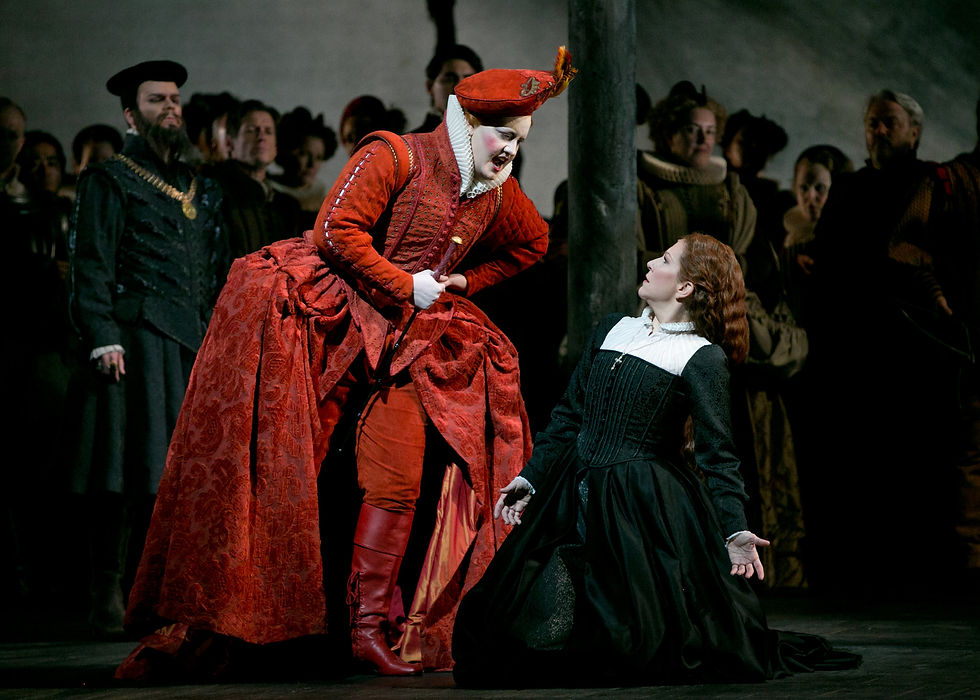
The Met revived the Copley production in 2018, with a stunning set of voices. Here's their summary. "Soprano Angela Meade is the fierce title monarch, whose quest for power comes to a halt with the discovery that the object of her affection, the warrior Arsace—sung by mezzo-soprano Elizabeth DeShong—may actually be her long-lost son.
Together, the two square off in a pair of dazzling duets and deliver some of the opera’s most challenging arias, including Semiramide’s famous “Bel raggio lusinghier.”

Bel canto specialist Maurizio Benini takes the podium to lead a cast that also stars tenor Javier Camarena as the ardent prince Idreno, bass Ildar Abdrazakov as the scheming Assur, and bass Ryan Speedo Green as the stern high priest Oroe."
More in their splendid introduction at the Met site here.
And a trailer here.
But that's all about the voices. The reviews tended to concentrate on the production. NYTimes headed theirs, ($) "‘Semiramide’ Returns to the Met, Unglamorous but Excellent." Singing, that is. "A stage full of Babylonian ruin and rubble is frosted in tarnished gilt. The costumes (by Michael Stennett) time and again challenge your notions of how many different kinds of fabric can coexist in a single gown. The efficiently gaudy show doesn’t have a deep thought in its head but, in its bombastic way, it’s modest and true." OperaWire headed theirs "Elizabeth DeShong Shines In Disappointing Revival" and concluded, "You don’t need a great director to realize that if two characters are in conflict, they should probably not be standing on opposite sides of the stage and looking away from each other for a full five minute duet; this was the case in the scene in which Assur and Arsace, great rivals for the throne, face off for the first time. Why not have them pace around one another, their gazes locked throughout? That would hint at some tension." "A gaudy stand-and-sing Semiramide at the Met" said Bachtrack. But "At least there was glorious singing to be heard."
And New York Classical put it simply "Met’s “Semiramide” delivers a visual and bel canto feast". "John Copley’s spectacular production, returning to the Met stage for the first time since 1993, offered ancient Assyrian splendor to match the composer’s fabulously ornate arias and lusty choruses.
But make no mistake–in a score conceived in the two traditions of opera seria and bel canto, spectacle and stage action took a back seat to the voice, the voice, the voice."
Full opera online?
Jessica Pratt played the warrior queen in a full opera that's on YouTube but with only French subtitles.
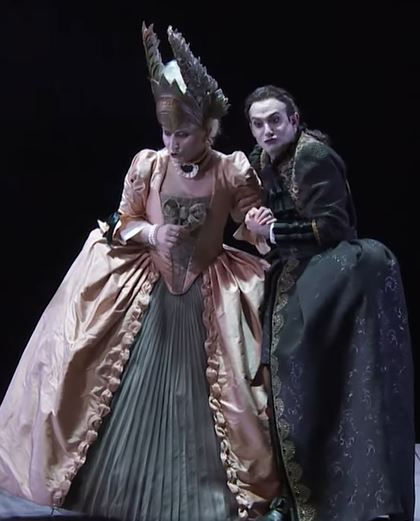
There is another full opera version, here, of another production on YouTube. Subtitles in English. It's from L’Opéra national de Lorraine à Nancy.
The performance is elegantly dressed and produced, but some reviews didn't praise the singing. (Some hated it!) But this reviewer interestingly reflected on the use of a countertenor for Arsace, the only operatic role Gioachino Rossini wrote for a castrato - now a part always played as a trouser role by a mezzo.) Franco Fagioli, the Argentinian countertenor, is much praised as a leading voice in Europe.
Lyn, 17/6/26
Comments