More than a mad scene

Donizetti's Lucia di Lammermoor, a very Scottish tale, premiered in Naples (in Italian) in 1835, and hit the French opera scene (in French), in 1839, the year before Daughter of the Regiment (in French) sealed his success in Paris. Tells you a lot about Donizetti's career and also about this old, old story.
Lucy in history
The libretto of the opera is closely based on one of Sir Walter Scott's more gloomy works, published in 1819. Apparently a favourite fireside tale his mother had learned from her mother, it became one of the many historical novels he offered to European Romanticism.. Here's the story of the story.
Settle in with Scott for a magnificent read, setting the natural and human context of the drama powerfully. It's available for free online here.
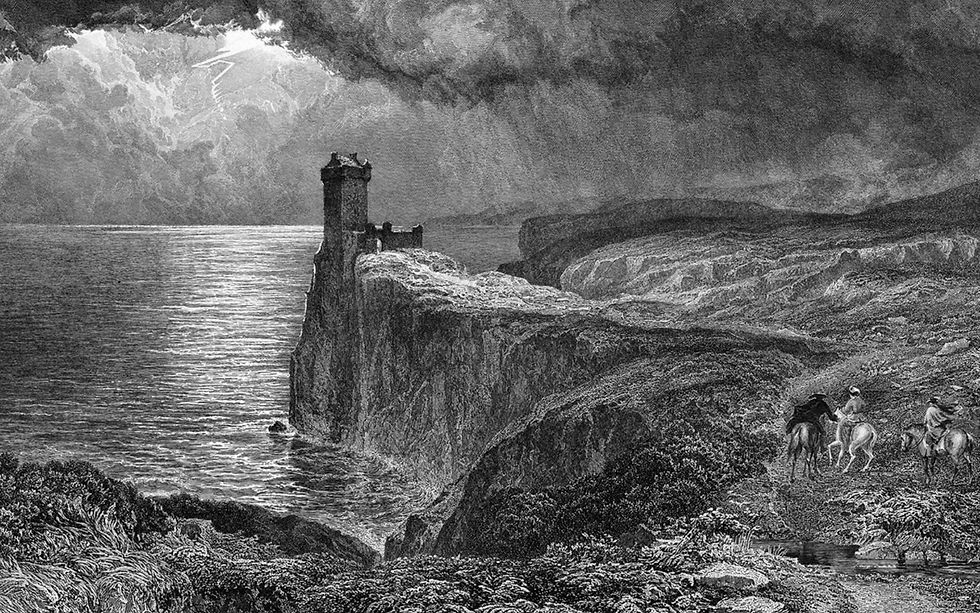
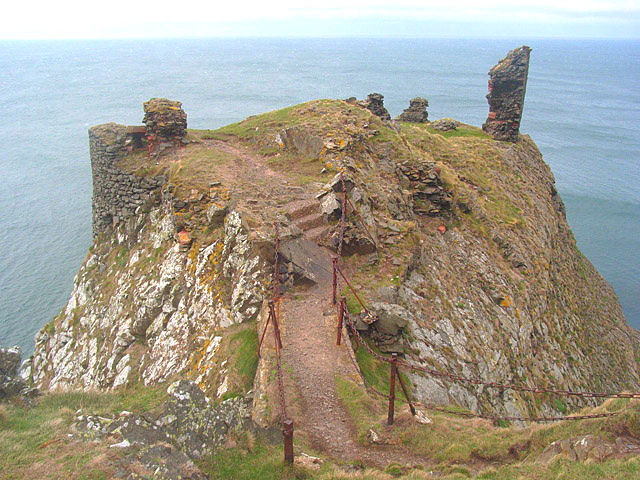
In the gorge of a pass or mountain glen, ascending from the fertile plains of East Lothian, there stood in former times an extensive castle, of which only the ruins are now visible. Its ancient proprietors were a race of powerful and warlike barons, who bore the same name with the castle itself, which was Ravenswood... Their history was frequently involved in that of Scotland itself, in whose annals their feats are recorded.
The Castle of Ravenswood... was of importance both in times of foreign war and domestic discord. It was frequently beseiged with ardour, and defended with obstinacy, and, of course, its owners played a conspicuous part in story. But their house had its revolutions, like all sublunary things: it became greatly declined from its splendour about the middle of the 17th century; and towards the period of the Revolution, the last proprietor of Ravenswood Castle saw himself compelled to part with the ancient family seat, and to remove himself to a lonely and sea-beaten tower...
This forfeited nobleman inherited the pride and turbulence, though not the fortune, of his house, and, as he imputed the final declension of his family to a particular individual, he honoured that person with his full portion of hatred. This was the very man who had now become, by purchase, proprietor of Ravenswood, and the domains of which the heir of the house now stood dispossessed.
That was Lucy's father, Sir William Ashton. Go to Chapter V for the delicious account of his and Lucy's rescue from the wild bull by - gasp! - Edgar, The Master of Ravenswood.

The man to whose timely interference they had been so much indebted did not seem inclined to leave his good work half finished. He raised Lucy from the ground in his arms, and conveying her through the glades of the forest by paths with which he seemed well acquainted, stopped not until he laid her in safety by the side of a plentiful and pellucid fountain, which had been once covered in, screened and decorated with architectural ornaments of a Gothic character. But now the vault which had covered it being broken down and riven, and the Gothic font ruined and demolished, the stream burst forth from the recess of the earth in open day, and winded its way among the broken sculpture and moss-grown stones which lay in confusion around its source.
Tradition, always busy, at least in Scotland, to grace with a legendary tale a spot in itself interesting, had ascribed a cause of peculiar veneration to this fountain. A beautiful young lady met one of the Lords of Ravenswood while hunting near this spot...

Google "The Bride of Lammermoor " and you'll get an idea of the characters Donizetti was to set to music. Here's a painting by John Everett Millais (1829–1896) in the Bristol Museum & Art Gallery. And here's the Commons.wikipedia summary. "Edgar, Master of Ravenswood, has just rescued Lucy Ashton from a wild bull. Lucy is the daughter of his enemy but she, unaware of his identity, is surprised at his cold manner. The artist's model for Ravenswood perfectly fitted Scott's description: 'A monteso cap and a black feather drooped over the wearer's brow, and partly concealed his features which, so far as seen were dark, regular and full of majestic though somewhat sullen expression.'
The story of the opera
Donizetti's librettist , Salvadore Cammarano, had a lot to deal with. These details are all there in his version of this tale - the lonely Scottish castle, the family feud, arrogant Ashton parents - though interestingly, Scott stressed a domineering mother, and Cammarano left her out! The opera begins with the wild bull and the romantic rescue in the recent past, and with Lucia's first beautiful bel canto aria, Regnava nel silenzio, about her meeting with the ghost of that beautiful Niaid at the broken fountain - and her love of Edgard, "beside him,/ Heaven opens up for me! " Here are the words, and Maria Callas. And that was just the story to Chapter V. The novel's complex plot is simplified from there.
The tale had already inspired four operas, but this one had it all. Lots more about the story and opera here.
Our production
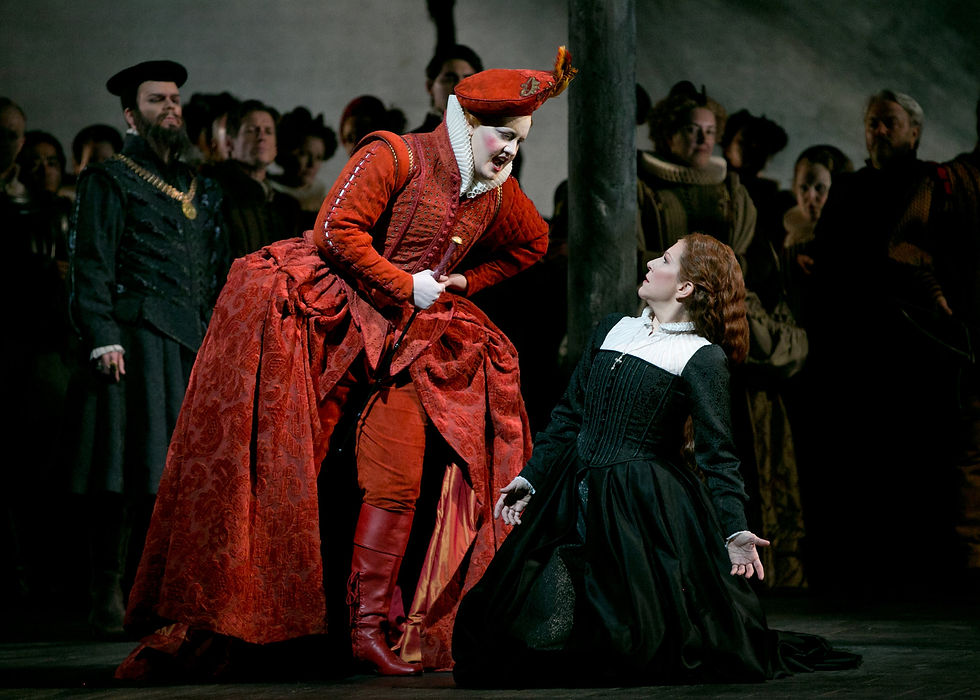
Mary Zimmerman is the director of this Met production, and Natalie Dessay first sang Lucia in it in 2007. Reviews then were mixed about Zimmerman's "Victorian ghost story" concept - including the Naid as a character - but exultant about Dessay.
The Met posted a video of the management of the set that gives a great insight into the production.
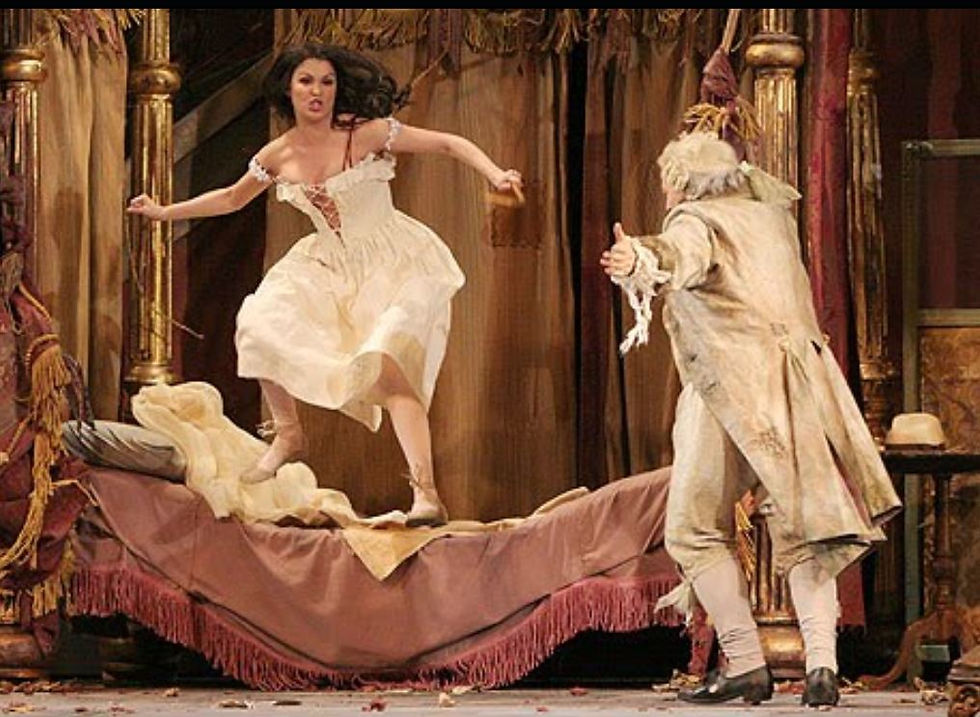
The Opera News reviewer commented, "In most "Lucia" stagings, Donizetti's ethereal music provides sufficient metaphor for the ghostly world. Zimmerman chose to have the spirits in "Lucia" literally present: as Lucia sang of the long-dead maiden she saw at the fountain, a young lady in whiteface crossed the stage and sank into the fountain waters. Perhaps a lesser-grade Lucia might have needed this metaphorical boost to put across "Regnava nel silenzio," but when the artist on offer is Natalie Dessay - who with this performance established herself as one of the great interpreters of Lucia in Met history - the device was a regrettable distraction. (Even more regrettable was the decision to have Lucia's ghost return, post-mad scene, to offer Edgardo silent assistance as he stabbed himself.)" But he had nothing but praise for the star. "Dessay's extraordinary Lucia, a performance as remarkable for its musical integrity and imagination - she sang the final cadenza without the traditional flute accompaniment, a device not composed by Donizetti - as for its dramatic acuity. Dessay's voice is not conventionally lovely, but its slightly astringent quality was deployed with cunning skill in the creation of a fretful young girl literally driven into madness. Dessay limned her gamine-ish Lucia with uncompromising honesty and impulsive litheness - even incorporating a genuine stumble into her Act I blocking on opening night."
Returning in 2011, she refined the role in a way Bachtrack nicely summarized. "For Ms. Dessay, Lucia is something of a signature role, and her excellent acting ability makes her a good fit for it. Lucia's histrionic character, her desperation and her ultimate madness are all brought out here, and with a superb voice, too. Dessay has a gift for capturing the fragility of her character, even in Lucia's more confident moments (as in “Ardon gli incensi”, in which she boldly takes and commands centre stage). By the end, we are so drawn into the character that there is a bizarre and chilling sense of normality about her madness and that incident with Arturo, her bridegroom."

"Ardon gli incensi", Lucia's sweet dream of marriage to Edgardo, is central in the 'mad scene'. Listen to two versions - here's Joan Sutherland. And here for contrast is the fragile Lucy of Natalie Dessay in our production.
Lucia today
In the mainstream repertoire, this opera is the most resilient, defying efforts to update the story and its messages. Three years ago, when we watched Joan Sutherland's famous Lucia, I wrote a post about "Lucia for our Times"- you can find it here. In an opera about patriarchy in a controlling society, centering on the gift of a young woman in marriage as a pawn in a power play, the questions asked by directors have to be asked. But most were not asked either by Scott or by Donizetti and his librettist - and "updated" productions have not proved popular. But reinterpreting Lucy remains a fine task for the bel canto soprano singing her.
As Natalie Dessay remarked to a reviewer, “music is not the last goal; it’s a way to achieve the goal, which is theater.” Review here.
Lyn, 27/10/26

Comments