Queens at war

Updated: Aug 19
Donizetti's Maria Stuarda appeared in 1835, 5 years after Anna Bolena, only three years, but eight operas, after his hit comedy Elixir of Love. Maria Stuarda was the third of his four Tudor Queens operas, catering to the European fascination with the lives and characters of Tudor royal women and especially Elizabeth. (In 1829 he had produced Il castello di Kenilworth, (the only one with a happy ending) and Roberto Devereux was still to come.)

True History?
Well, no - the detailed story of this opera was an invention of German dramatist Friedrich Schiller - whose stories and plays launched at least 20 operas.
But Mary Stuart, in the opera ex-Queen of Scots, and Elizabeth, daughter of Anne Boleyn, are of course historical figures. They were sort of cousins - Mary Stuart was the grandchild of Henry's older sister. (To be distinguished from Mary I, or Bloody Mary, who was the daughter of Catherine of Aragon, Henry's first wife and briefly Queen of England before Elizabeth.)
Here's the family tree...

Mary and Elizabeth never met, though they exchanged letters. Mary had a strong claim to the English crown as the great-granddaughter of Henry VII, so a face-to-face meeting during her 19 years' imprisonment in England was unthinkable. The extraordinary scenes of their confrontation in the opera were Schiller's invention. Here's a clip from that famous scene in the production we'll be watching - in the version restored years after the original was banned.
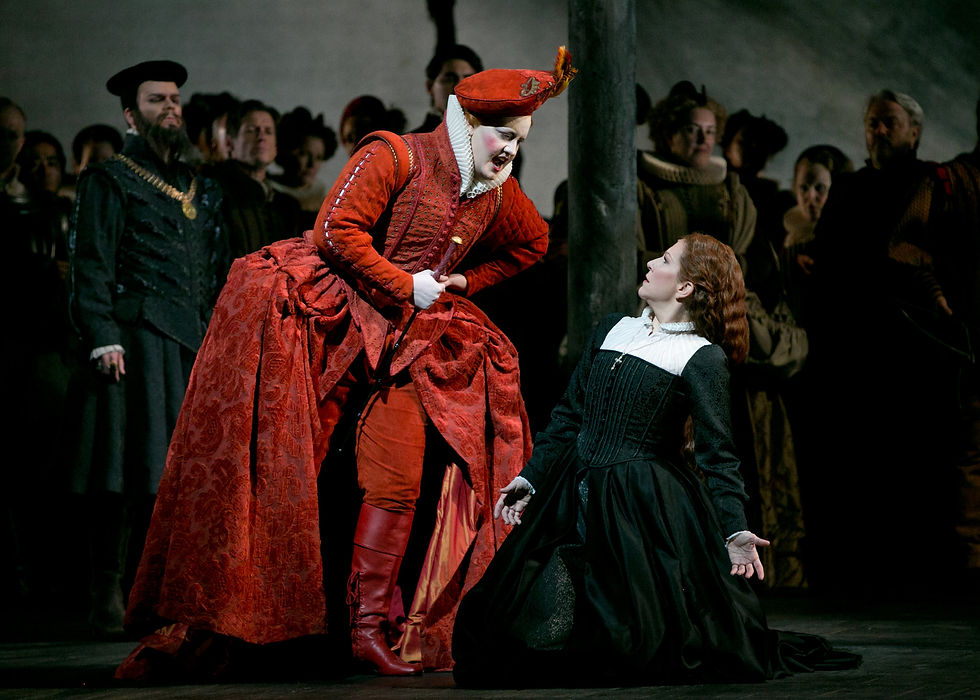
That climactic scene was the main reason for the opera's banning by the King of Naples (whose wife was a relative of Mary!) Donizetti, who had a number of his works censored or banned, adapted the opera - its long controversy and rewriting is told here.

It was certainly a shocker, and still is.
Figlia impura di Bolena, / parli tu di disonore? / Meretrice indegna e oscena, / in te cada il mio rossore. / Profanato è il soglio inglese, / vil bastarda, dal tuo piè!
[Translated as: "Impure daughter of Boleyn, do you speak of dishonour? Prostitute — unworthy and obscene, I blush for you. The throne of England is sullied by your feet, vile bastard!"]
Music
This opera is famous among Donizetti's dramas for its radical compositions, especially freeing the conventional duets of early Romantic opera from required structures. The music around the prolonged vituperative shouting match between the Queens at the end of Act 1 gives "the climactic moment something of the immediacy of the spoken theatre. In any sense, this dialogue is one of the most original and powerful passages that Donizetti ever composed" More here.
Synopsis
It's another opera whose ending is inevitable, but the drama leading there is complex.
"Two Queens. One Catholic and Scottish, one Protestant and English. One in prison at the other’s behest. A man between them balancing loyalty and love. A cry of ‘Vile bastard’ is the impassioned insult that leads one to the scaffold." This site has a full synopsis and interesting commentary.
Our production

We're streaming from the Met Opera in New York, which finally celebrated the Donizetti Queens with Anna Bolena in 2011 and this production in 2013, directed by David McVicar. on his best behaviour. Maria is played by a young Joyce DiDonato, (left) establishing herself "as one of the greatest of the singer-actors of her generation ".
A young Elza van den Heever makes her Met debut as Elizabeth, with Matthew Polenzani as the man in the (fictional) triangle, Earl of Leicester. Maurizio Benini conducts.
Lyn, 18/8/26

Comments