Rossini serio - Otello

Rossini reigned king of opera buffa by February 1816 (Barber of Seville) and La Cenerentola followed in January 1817. But between these buffa gems, he inserted Otello (December 1816). This rapid alternation of buffa and seria, always challenging the 18th century formulae, continued until his early exit from opera aged 37. His final opera, Guillaume Tell (William Tell), was a seriously seria drama about nationalism and liberty. Was it just showing off (he was good at that) or was there a motive behind the mixing of funny and tragic?
Here's one answer: he aimed to change both types of opera, and in similar ways. In the comedies, ‘he embellished his melodies (he was the true creator of bel canto, a florid style of singing), animated his ensembles and finales, used unusual rhythms, restored to the orchestra its rightful place, and put the singer at the service of the music..." And from his first serious opera, Tancredi (1813) "he tried to reform opera seria (the formula-ridden, serious operas of the 18th century), and he composed an authentically dramatic score. This work, spirited and melodious, was an instant success." More here.
There was then and still is an image of Rossini as "a gifted but feckless amateur, who at an early age abandoned his career to the otiose pleasures of the table", but as Richard Osborne writes, this image "bears no relation to the facts of the career as we have them".
The man, who in his lifetime was happy to cultivate a mask of casual unconcern, was in reality an odd mixture of affability and reserve, industry and indolence, wit and melancholy. And there were other paradoxes, too. A classicist by training and a conservative by inclination, Rossini nonetheless broke the mold of the old Italian operatic order and laid the foundations for a new generation of romantically inspired music-dramatists. The persona foisted on the young Rossini by an adoring public was, in fact, little more than an agreeable fiction. Yet it was a fiction which provided Rossini with the protection he needed: both as a creative artist anxious to make his mark in a rumbustious and changing world, and as a man increasingly prey in his later years to debilitating bouts of physical and mental illness. The truth is, Rossini was not only one of the most influential, he was also one of the most industrious and at the same time one of the most emotionally complex of nineteenth-century composers."

More on Rossini's musical innovation here.
(All genres are good except boring ones.)
For this winking image, compliments to our ABC -watch their intro video here.
Otello
"Rossini's Otello is an important milestone in the development of opera as musical drama." (Wiki, with lots more detail.) That was not a new idea - both Monteverdi and Gluck had insisted on the flow of drama rather than the static combination of music and recitative - both taking that idea to the legend of Orpheus. But by early 19th century, the orchestras and staging and the training of dramatic singers, made opera-as-drama more attainable. (Wagner's version was still to come.)

It's an old story. Shakespeare's primary source for his Othello (1603) was a short story, "Un Capitano Moro" (A Moorish Captain) , in 1565, by the Italian writer Giovanni Battista Giraldi Cinthio. According to Bell Shakespeare, "Cinthio’s story is a racist and didactic tale, warning European women to obey their parents, and not to marry men of different races."
Rossini's version in turn isn't Shakespeare's - apparently he and his librettist used a French adaptation of the story. So, unlike Verdi's later opera, it differs from the Shakespeare play in plot and characterisation, and uses none of Shakespeare's text. This version made more of the role of Roderigo, and thus needs three very strong tenor singers, which may have contributed to the opera's relative obscurity since its highly successful premier.
But Rossini's opera was a turning point for music drama. " For one thing, it was unambiguously and unfashionably tragic. (As late as 1820 censors forced Rossini to substitute a happy ending before the work could be performed in Rome.) More importantly, it was also one of the first operas to place any importance on the individual rather than relying on spectacle. Otello's denouement is one of the first Romantic tragic endings, and helped set a trend for Italian opera that was to last throughout the century." More here
"The plot of the libretto differs greatly from Shakespeare's play in that it takes place wholly in Venice, not mainly on Cyprus, and the dramatic conflict develops in a different manner. The role of Iago is much less diabolical than Shakespeare's play... In further contrast, the role of Roderigo, a sub-plot in Shakespeare and Verdi, is very prominent in Rossini's version—some of the most difficult and brilliant music being assigned to the character Rodrigo." Here's Wiki.
And if you're drawn back to Shakespeare, his play is here.
Our production

The tenors for this production are John Osborn - image left (in "blackface", 2012) , Javier Camarena, and Edgardo Rocha. And mezzo Cecilia Bartoli (below) is Desdemona.
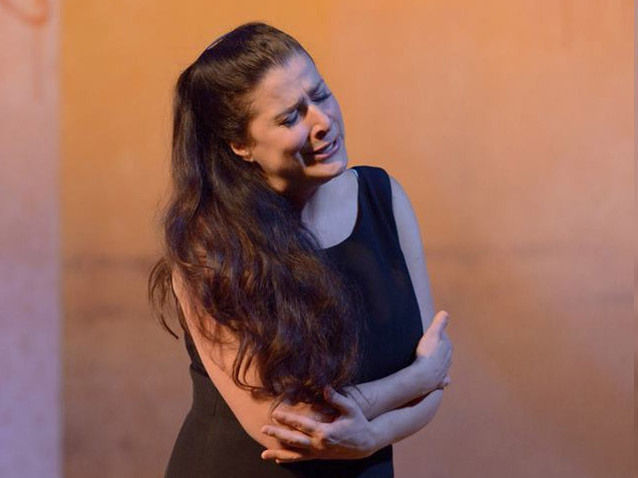
Surprisingly, it's in modern dress and settings, with no negative reviews of this. The update is discreet, as this review puts it. "The Venetian setting cannot be changed – what would become of the offstage gondolier’s song which has haunted audiences down the years? – nor does it require any special directorial intervention to point up the elements of racial conflict which Maria Berio’s libretto makes no attempt to disguise. Men in suits congratulating a successful commander-in-chief whose colour is a problem for some is not without its contemporary resonance."
Cecilia Bartoli is Desdemona
She's no ordinary diva (if there is such a thing). And her long diva career is no ordinary one. The Guardian reviewer in 2001 at Covent Garden - read his fine account here.
'The music convinces me,' she said of such moments when a passion takes possession of her. 'I believe the text, I feel it. That is what I am always looking for: words so intense that you can find music in them by colouring the voice or changing dynamics or giving them a different accent. It is what Monteverdi was after when he invented opera!'
In ($) 2012, the NYTimes critic wrote, "About 15 years ago the mezzo-soprano Cecilia Bartoli seemed to be taking New York by storm." she had three new productions at the Metropolitan Opera from 1996 to 1998. She hasn't sung there since.
There were rejected offers and cancellations due to illness, and she found other companies that were more comfortable presenting the 18th- and 19th-century rarities that she favored. The Zurich Opera became one of her home bases, and last month she introduced a major new role here: Desdemona in Rossini’s rarely performed “Otello.”
On Thursday evening, at the fourth performance in the run, Ms. Bartoli, 45, displayed both the quirks and the dazzling strengths that have characterized her work since the beginning. She still has a small but penetrating voice with a dark, unsettled tone, and she still mushes many of her pitches.
It is a testament to the visceral excitement of her sound, with coloratura runs popping like BB gun pellets, that you don’t find yourself caring too much that her singing is not quite flat and not quite sharp, and often not quite in tune, either. It helps that her voice is a flexible instrument that she can do most anything with; near the end of the opera, for example, she narrowed it to a lacy sliver for the aching Willow Song. (More here but $paywall)
A Zürich production, it was performed later in Paris: see review of that performance here.
It's online here, on YouTube, but without subtitles.
Lyn, 19/5/26
Comments