Figaro here, Figaro there...

Updated: Jun 4
The Barber of Seville was Rossini's 17th opera, (in 6 years!), composed in barely three weeks in 1816, when he was only 24 years old . Since it has been regularly his most renowned opera buffa, arguably the most renowned. Check out Bachtrack's review list for recent years.

That story
It all started with Pierre Beaumarchais's three part French comedy The Barber of Seville (1775). The characters featured in several other operas, all now forgotten except Mozart 's Marriage of Figaro (1786). Confusingly, Mozart's librettist had worked with the second play, which portrayed a later life-stage for Rosina and the now bored Count, who had acquired Figaro as a servant.
Thirty years later, Rossini's librettist returned to the first play, in which Figaro is a barber and a "factotum" in the town where a young Rosina lives with a controlling elderly guardian who plans to marry her. Enter the young Count, pursuing her with the help of guess who. Cue a famously lively overture (recycled from earlier Rossini operas), a fast moving plot of laughs and patter songs and some of his loveliest music.

Playing it classically
You can choose from many delightful Barbers online - and almost all are classic productions, in traditional sets and costuming including big wigs. Best of the full opera offerings, are the following:

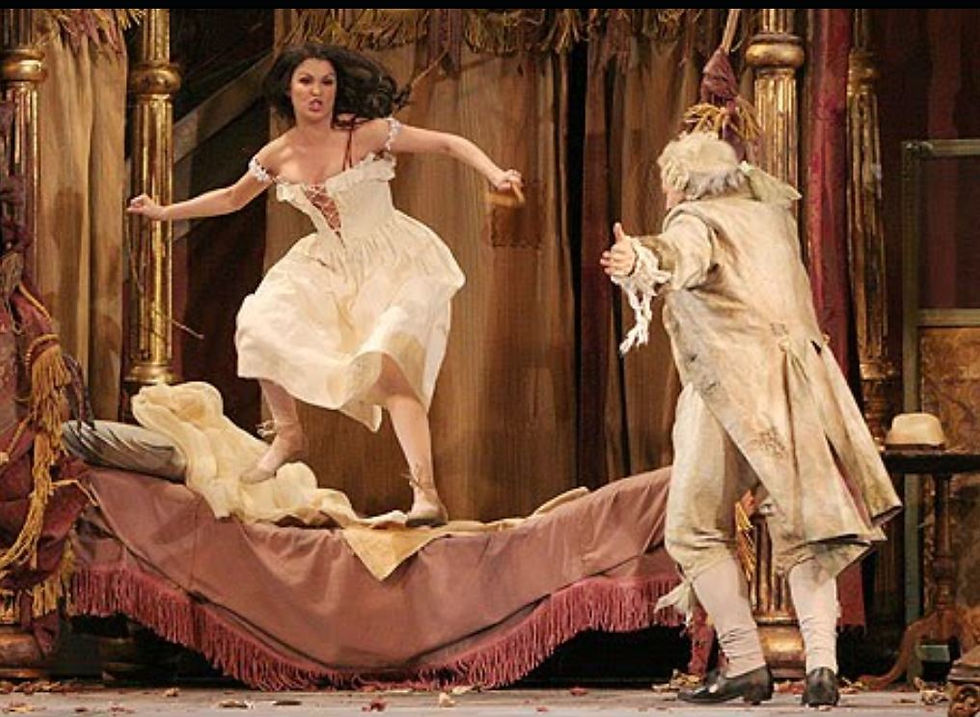
*Jean-Pierre Ponnelle's production 1972 for La Scala with Herman Prey (right) and Tereza Berganza.
We've watched this 5 years ago in our group - here's our blog in 2019.
*Watch it in the Area at Verona with Leo Nucci at age 76 playing Figaro, a mature cast in a difficult setting, highly praised.
*If you don't need subtitles by now, try
Sarah Caldwell's production in 1976 with Beverly Sills, Alan Titus, Donald Gramm, Henry Price, and Samuel Ramey.
More recently, from the Schwetzingen Festival (1988) comes a traditional production starring a young Cecilia Bartoli (above) as Rosina. Here's her aria "Una voce poco fa" "What sets this... apart from all others available is its elegant realism. None of its visuals are the least bit cartoonish or blatantly designed for comedy." More here.
*In 2007, the Met produced a Barber of Seville starring Joyce diDonato and Juan Diego Florez. It's not on YouTube - Met doesn't. But they screened it during Covid - here's our blog. And here's Joyce DiDonato's 'Una Voce Poco'. Surely at that time the two were the top Rossini soloists, and it was a delight. but as this reviewer comments, it lacked the madcap pace and sound the opera requires.

And of course the theme song of the barber, 'Largo al factotum' is the joy of operatic baritones. Here's Herman Prey.
And for the fans, here's Dmitri Hvorostovsky - in Japan 2005.
Or early in his brief career, (photo right) 1992 in Liverpool.
Here's Glyndebourne's Figaro, Bjorn Burger, as accompaniment to the trailer of the production we're watching.
Our production
So in defiance, we are screening a modern presentation that is deliberately 'cartoonish'. Annabel Arden's new production for Glyndebourne in 2016, on the opera's 200th anniversary. It's a French play made into an Italian opera, but Arden chooses to place it in Spain, with a set made of colour and pattern and costuming to go with it (including Balenciaga-inspired dresses for Danielle de Niese as Rosina. Arden says in her program note the production is “about taking inspiration from the Spanish tradition of the grotesque and the marvellous and making a synthesis of it.” More from the Guardian here.

The cast is great. Björn Bürger is a very different Figaro from Herman Prey or Leo Nucci - let alone the Met's Mattei. And the Rosina from Danielle de Neis is a different Rosina from the traditional characters - pouty, spoiled and much more fun. Here's Danielle's Una Voce. And Glyndebourne offers lots of information.
And Dr. Bartolo, the maligned elderly guardian, is played and brilliantly sung, patter and all, by the brilliant Alessandro Corbelli. As this reviewer noted: "For Alessandro Corbelli, performing the role of Dr Bartolo must feel as effortless as putting on his slippers and sipping a night-cap: but, however familiar it all feels, the baritone doesn’t let a detail pass him by, and - as far as Arden’s direction allows - gives a masterclass in comic nuance, balancing understatement with hyperbole, with spot-on timing."
This performance won mixed reviews - praise for the singers and orchestra, but criticism of the farcical production. The criticism is spelled out here, in Opera Today. "All in all, this is an enjoyable production with rich pickings both visually and vocally. If only the beautiful designs served the rich, human comedy." Bachtrack commented that the production, "although decently sung and visually striking, is seriously under-directed, allowing forced acting to blunt the humour.' In subsequent years, new directors have toned down the slapstick. But was it necessary to do so? The show was a hit at the Proms after all - see this review!
Lyn, 3/6/26
Comments