Fidelio - Beethoven's “problem child”

Updated: Feb 12

from Lyn Richards.
Why did Beethoven turn, just once, to opera? Not just any opera, but one dramatically depicting the struggle for freedom and the triumphant joy of love and fidelity winning over tyranny. These were values dear to him his whole life: perhaps, at this crisis stage of his life, with libretti on offer, he saw a chance of depicting them through human characters.
In October 1802, when he was 32, Beethoven had written the Heiligenstadt Testament, a searing letter to his brothers on his despair at his increasing deafness. Listen here to John Bell's reading of this famous document.
Then on 20 November 1805, his first, and only, opera premiered in Vienna.
Fidelio was first performed in very difficult circumstances. Napoleon was laying siege to Vienna, the audience was largely French officers who grumped at a German language opera. Beethoven revised it several times, describing it as his "problem child". Its final version is from 1814, after many criticisms of its joining domestic comedy (Act 1) with opera seria. Full libretto is here.
Fidelio
Many in our group have met this opera in 2023 - here's the link to my blog post then. There's full detail of course on Wiki, here, including a synopsis. Easier to find is the synopsis from the Met.
It's the story of a noblewoman, Leonore, who dresses as a boy to get employment as a prison guard - “Fidelio” - in order somehow to rescue her husband Florestan, who is a political prisoner, victim of a ruthless tyrant, Pizarro, whose injustice Florestan has exposed. (Spoiler alert: yes, he's rescued; in one of the most unpersuasive and undramatic last scenes in opera.)

Even during the early domestic comedy, the libretto and the music celebrate the power of love and fidelity, but focus on the political struggle for liberty and justice. At the start of the nineteenth century, of course, they were mirroring contemporary political movements - as relevant at the end of the century and now. Listen here to the prisoners' chorus.

There's a video here of Daniel Barenboim reflecting on the ways Beethoven created music that expressed the triumph of freedom, conducting one of the versions of the overture: Leonora no 2.
On my 2023 post, you'll find details of a production in Leonard Bernstein's Young People's Concerts. He introduces Fidelio as one of Beethoven's greatest works, "containing some of the most glorious music ever conceived by a mortal, one of the most cherished and revered of all operas, a timeless monument to love, life, and liberty, a celebration of human rights, of freedom to speak out, to dissent. It's a political manifesto against tyranny and oppression, a hymn to the beauty and sanctity of marriage, an exalted affirmation of faith in God as the ultimate human resource." You can read the text of that presentation here. (Sadly, the video of the concert is no longer available.)

"Abscheulicher! wo eilst du hin?" "Monster!" she cries, "Where will you go?" (Lyrics here)
It's the emotional centre of the opera and a tough one for the soprano singing Fidelio. Leonora has heard Pizarro plot to murder her husband, erupts in horror - (recitative - "Abscheulicher!") then calls on hope in a tender aria ("Komm, Hoffnung, lass den letzten Stern..." - Come hope, let not the last bright star/ In my anguish be obscured!). She finishes the plea in a fast, determined cabaletta.
Here's Christa Ludwig. And Jesse Norman, 1989. Here's Elisabeth Schwarzkopf in 1954.
Between classical and romantic
Fidelio is regularly seen as bridging the classical and romantic stages in opera, albeit not very successfully. The 1814 version we see most often now played, cut a lot of the Singspiel (German for "sing-play") comedy. But it still had the signs of Beethoven's extraordinary matching of music to mood, wonderfully shown by the quartet in Act1, "Mir ist so wunderbar" where four troubled people sing to themselves their different understandings of a complex situation. Here it is from the ROH production we'll view. And here's another version of the prisoners' chorus, when "Fidelio" has persuaded the jailer to let them come into the sunlight.
"No other work of Beethoven’s caused him so much frustration and disappointment. He found the difficulties posed by writing and producing an opera so disagreeable that he vowed never to compose another. In a letter to the librettist assisting him, he said, 'I assure you, dear Treitschke, that this opera will win me a martyr’s crown. You have by your co-operation saved what is best from the shipwreck. For all this I shall be eternally grateful to you.' But he also wrote, 'it is the work that brought me the most sorrow, for that reason it is the one most dear to me.'" More here.
So the 1814 version lasted. "Usually, ... I think rightly, the 1814 version is preferred on grounds of its moving depiction of the struggle for freedom. This is the core of Beethoven, and he was never comfortable with the genre of domestic comedy, particularly when it involved erotic relationships. (He said that Mozart’s Marriage of Figaro was an ignoble work.)" More here. And directors now differ in their reading of the opera. Bachtrack provides here a comparison of the interpretations by three directors, including Kratzer who directed the ROH production, one of the three we'll be viewing. He's quoted as saying, “Fidelio is probably the first opera in the history of the genre to experiment with the form and premises of opera itself to communicate a higher (that is, a highly personal and highly political) message...My task as a director is therefore not to "solve" a problem, but rather to make the special structure of this opera visible to the audience – and try to make what might be considered a weakness of the piece a strength of its own.”
Our productions
We have three very different productions of this challenging opera to explore, one traditional, the others offering different ways directors have tried to remake Beethoven's message.

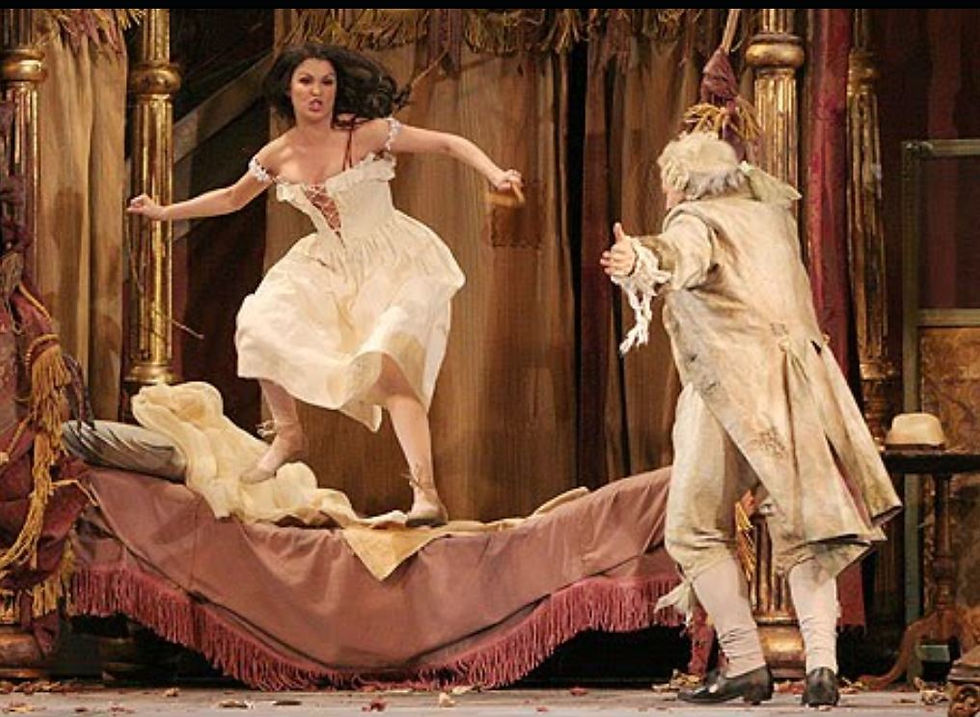
Back in 2004, we have Nicholas Harnoncourt conducting a Zurich production, directed by Jurgen Flimm, with Jonas Kaufmann as Florestan and Camilla Nylund as Leonora. The leads were both given rave reviews. "Really this production only comes alive in Act 2 and these two make that happen." But the same critic chafed at the traditional production. "It’s not offensive and it doesn’t really get in the way of the story but it seems quite devoid of originality."

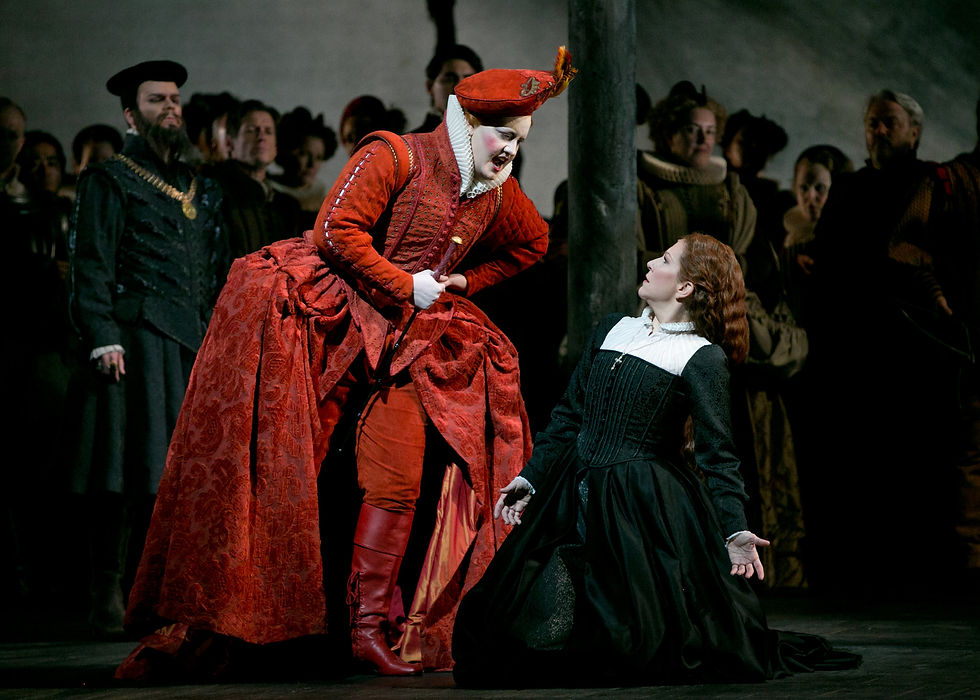
In total contrast is the highly controversial 2015 Salzburg production directed in a complex, Freudian? reinterpretation by Claus Guth with Adreanne Pieczonka and Jonas Kaufman as the leads.
Reviews were very negative - check them out: Seen and Heard. The Opera Critic. Guardian. Gramaphone.

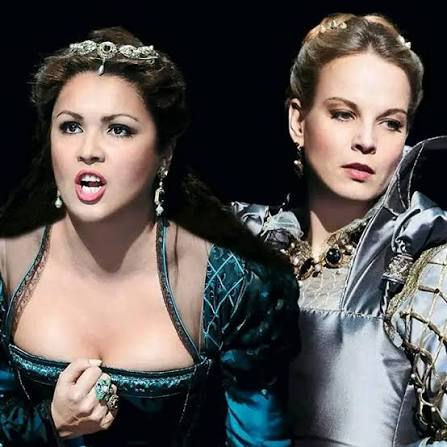
And then the ROH production directed by Kratzer, 2020, with Lise Davidsen in the title role and David Butt Philip as Florestan (replacing an ailing Kaufman - as in the image right!) It's this version we'll play in our sessions.
The singing is much praised, though the director's reworking of the story, especially the final act, troubles this critic. "Kratzer’s point, that the silent majority all too frequently resist political engagement until after events have nearly run their course, unquestionably resonates with our own times, but has little to do with Beethoven’s vision of divine providence working through human activity to establish true justice on earth."
Ode to Joy
After Fidelio, Beethoven went on to compose the Missa solemnis between 1819 and 1823 and then his final Symphony, No. 9, the first major example of a choral symphony, between 1822 and 1824. He was by then completely deaf. "The audience acclaimed him through standing ovations five times; there were handkerchiefs in the air, hats, and raised hands, so that Beethoven, who they knew could not hear the applause, could at least see the ovations." He died in 1827.
Like Fidelio, the Ninth was a call for freedom, and its Ode to Joy, from a poem by Schiller, has become a theme song in movements supporting political prisoners. Details and English translation here.
Here's the London Philharmonic in 2.25, playing the whole Ode to Joy from the last movement. If you don't have time to listen to the whole, go to 6.58 where the bass, the first single human voice, enters - "Oh freuden..."
How operatic!

Comments